



GreenPixel Games: Localization Case Study

GreenPixel Games: Localization Case Study
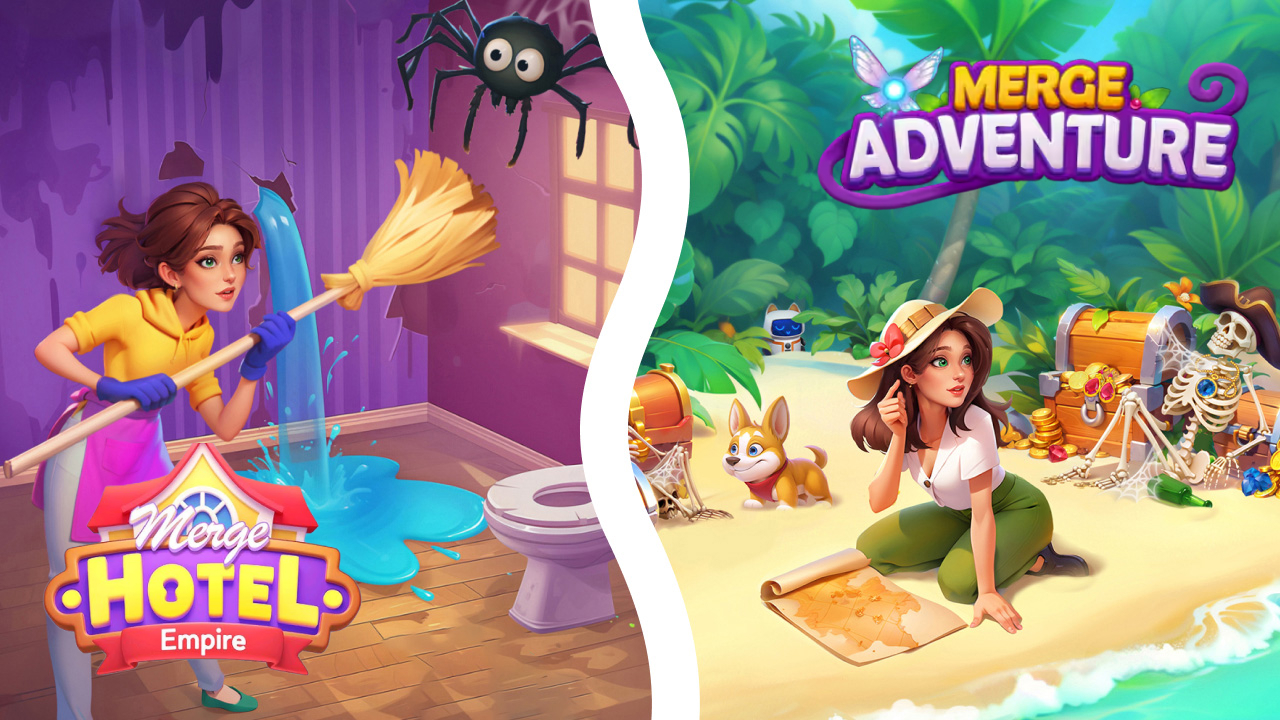
INLINGO has been working on GreenPixel games for four years. Each project has its own language pairs, stylistic requirements, and goals, but they all share one thing: a passion for detail and a strong focus on context. This case is about how we localized two games with merge mechanics. Read on to learn about our approach to game localization, the challenges we’ve faced, and how we’ve overcome them.
*The case mentions games that were developed by the GreenPixel team. The copyrights for some of the projects now belong to another company.
About the GreenPixel Games We’ve Been Working On
In the merge format, a casual game mechanic, players combine identical items to create new items that are more complex or useful. For example, two pots can be combined to create a kitchen appliance that unlocks a new area or task. This mechanic forms the core of the entire series we’ve been working on.
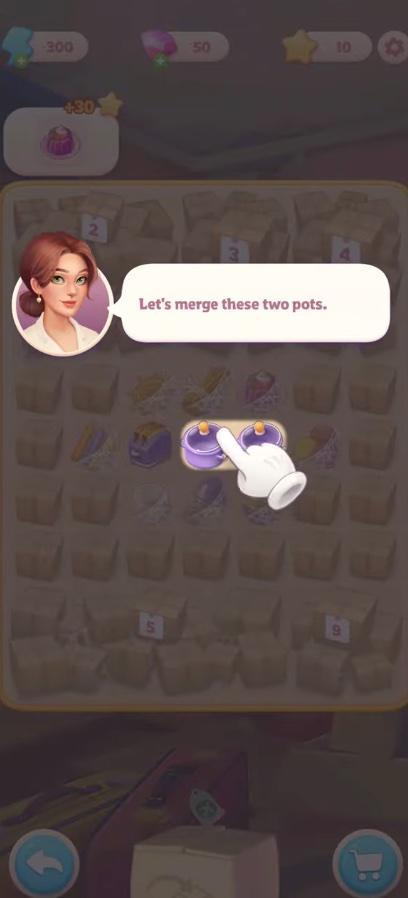
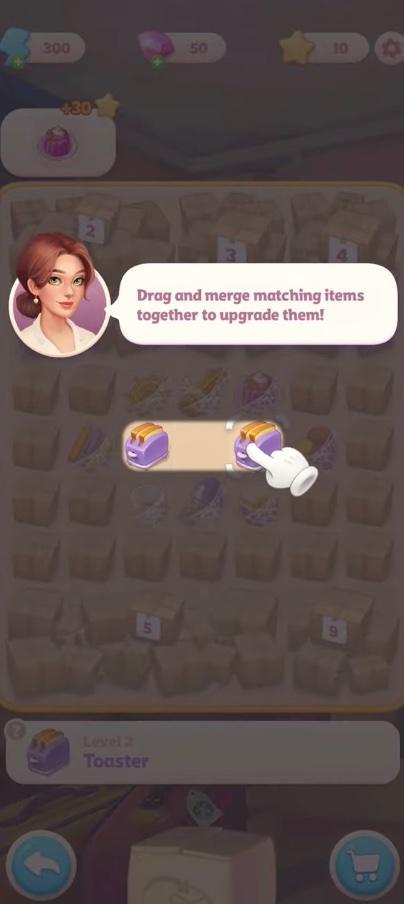
When these two pots are merged, they make a toaster.
Decorating Game
The game combines merge mechanics with hotel renovation and decoration. The protagonist is an ordinary young woman who has spent her whole life working in retail. On her thirtieth birthday, she decides to turn her life completely around by pursuing her long-held dream of opening a family hotel. She finds an abandoned villa in the suburbs. Once a luxurious mansion, the villa is now in serious disrepair.
However, the protagonist is determined to restore the villa to its former glory. Together with the player, she begins renovating the mansion room by room: fixing what’s broken, choosing furniture and décor, and bringing the garden back to life. Every interior element is the direct result of the player’s actions through merge gameplay.
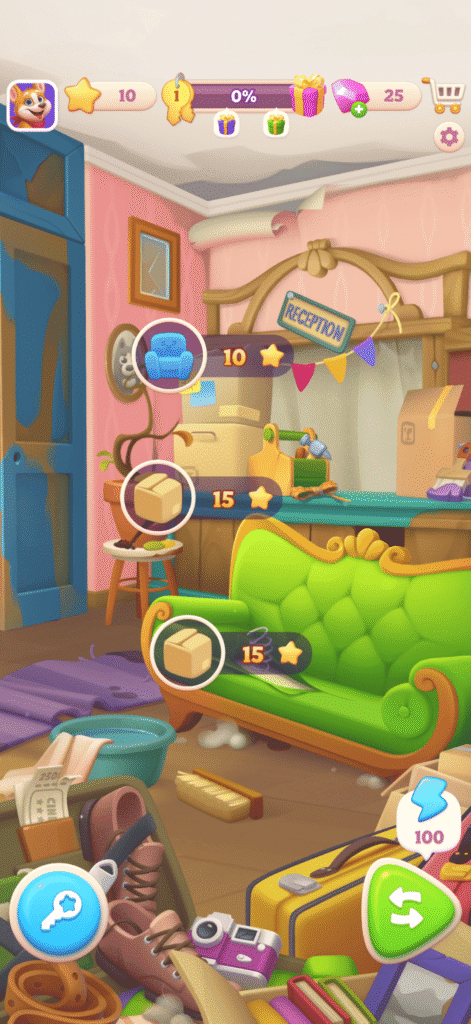
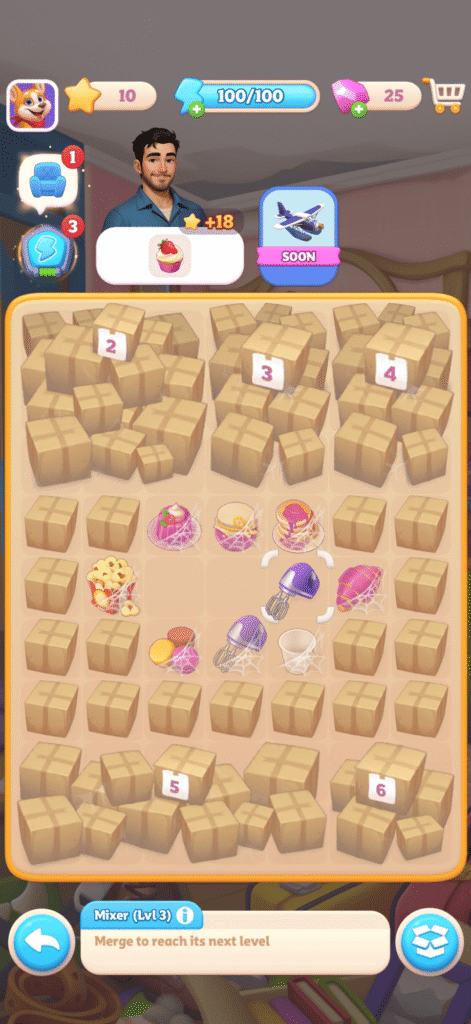
Decorating game
To get the hotel up and running, the protagonist must solve a number of mysteries, uncover the secrets hidden in the villa’s past, and prove that no curse can stop a dream from becoming reality.
Adventure Game
This title puts an adventure-focused spin on merge mechanics. This is a new part of the story that complements the previous game. After her hotel becomes successful, the protagonist’s uncle invites her to a mysterious archipelago full of hidden secrets, ancient ruins, and traces of vanished explorers. Leaving home behind, she sets out to help her relative rebuild an old tourist town and restore it to its former glory.
Players explore islands, jungles, and ancient temples alongside the protagonist, using merge mechanics to progress. Each merge brings them closer to uncovering the next secret, whether it’s the mystery of her uncle’s missing friend, the truth behind a treasure-hunting corporation, or the archipelago’s own hidden past.
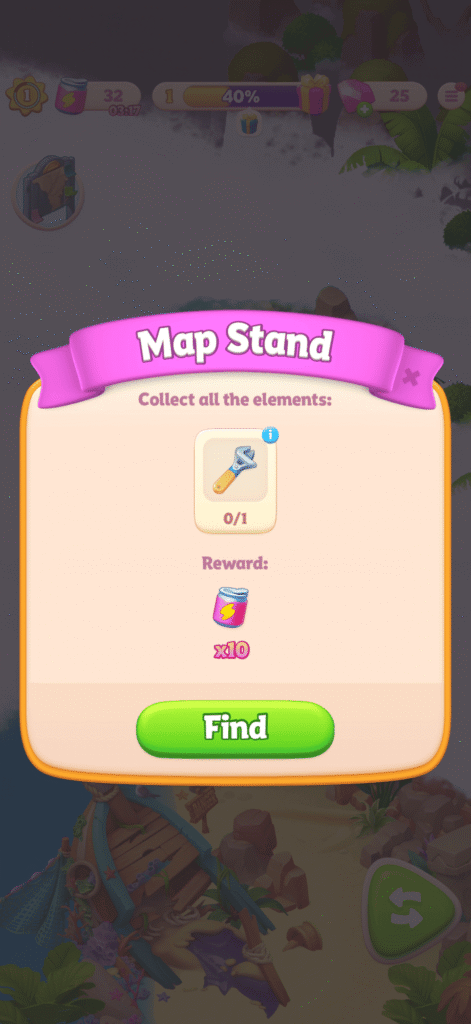
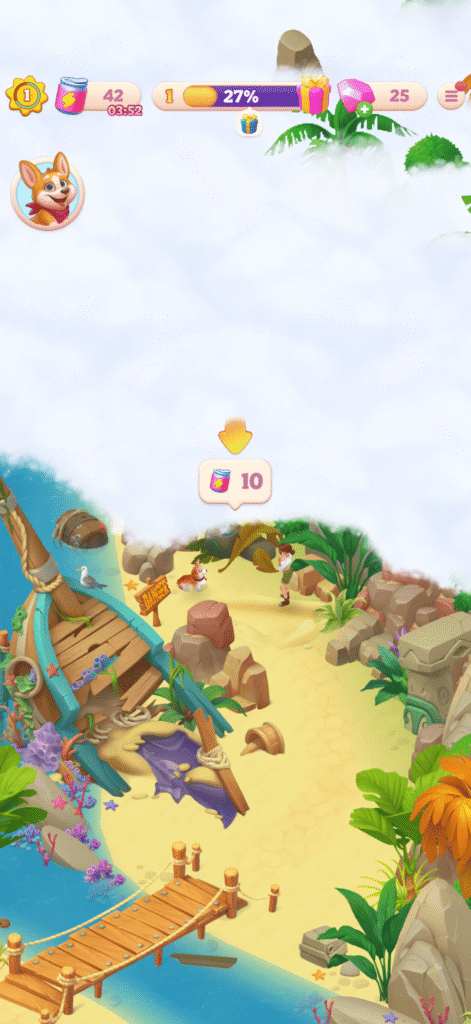

Adventure game
String length limits are especially important in merge-based games to ensure that names and descriptions display properly. Character voicelines and atmospheric dialogue must be adapted for each language while preserving humor and character voices. The game interface (e.g., Merge Board, Storage, Order, Room Upgrade, etc.) must remain intuitive for players.
Project Scope
Our collaboration with GreenPixel began in February 2021 when they approached us with their first title.
Over the years, we have localized the series into more than 12 languages: English, German, Spanish, French, Italian, Brazilian Portuguese, Arabic, Japanese, Korean, Thai, Turkish, and Vietnamese.
Irina Grin
Project Manager
Over the years, the GreenPixel team has come to see the projects we work on as more than just individual tasks. Our translators and editors approach each new file with the same enthusiasm as fans waiting for the next episode of their favorite show. Projects should feel that heartfelt and engaging—and that’s why everyone involved in localizing GreenPixel games takes real pride in their work.
Localization for GreenPixel in numbers
13
languages
650,000
words per language
4
years of collaboration
36
translators
5
managers
13
editors
5
task per month
How We Organized Workflow
Each task followed the same process, which involved the client sending us a file with a deadline and us ensuring the timely delivery of the multilingual files.
Together with the client, we gradually developed a system that allowed us to:
- Clarify all limits in advance (including per-line timing limits for dialogue)
- Receive visual references and information about who is speaking
- Improve file formatting by adding comments and context directly in the workflow
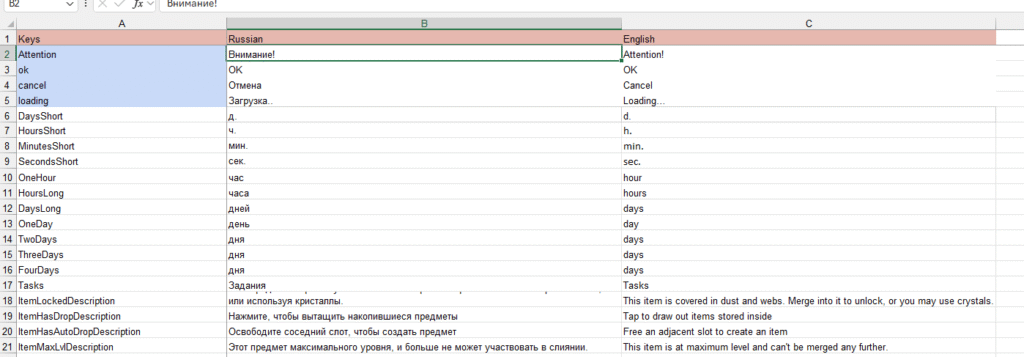
What client files looked like at the start
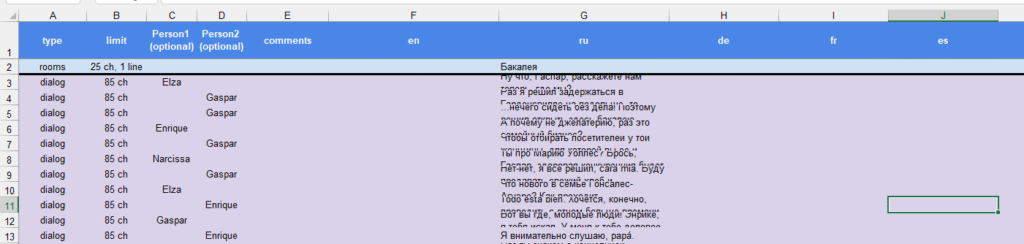
What they look like now
Anastasiia Rynkovaia
Front Project Manager
I’d like to highlight how responsive the GreenPixel team has been in improving the file structure. As the files have become more detailed, translation now takes less time—everything is clearer, and the team has fewer questions to ask. Our work has become faster, more efficient, and more enjoyable because our linguists can now rely on the full context to deliver the best possible version for their respective locales.
How We Assembled the Project Team
For this project, we selected translators who genuinely love games in the merge genre. Nearly everyone on the project team actively plays both games. Their familiarity with and enthusiasm for these games helped them understand the context, jokes, and character dynamics intuitively. The project team was multilingual, and our editorial group ensured consistency across languages, maintaining a unified tone and lore across all versions.
Ekaterina Korbova
Lead Project Manager
The warm atmosphere on GreenPixel projects is largely thanks to our managers, Anastasiia Rynkovaia and Irina Grin. They pay close attention to every file and always make sure that translators and editors have all the necessary information and comfortable working conditions. I must also mention Inlingo’s Editor-in-Chief, Galina Derevyanko, and Localization Engineer, Igor Kamerzan, who handle error processing and quality control. Their meticulous approach guarantees that no detail slips through the cracks. Thanks to their combined efforts and dedication, our work has been smooth and of high quality for many years.
The Errors We Helped Identify and Fix
We’d like to share some interesting observations we encountered while localizing GreenPixel games—and the insights we gained from them. There were unique cases in every language.
Spanish: The Robot Cat Who Turned Out to Be a “She”
The game features a robo-cat whose name is somewhat similar to one of a world-known scientist. For a long time, the text did not make it clear that the character was female. Once we confirmed this with the client, we added this information to the style guide and updated the glossary. We changed the character’s name so that it still resembles one of a scientist but sounds like a female name.
Irina Grin
Project Manager
While working on one of the files, our team had a question: Is this character a cat or a tomcat? She had only recently appeared in the story at that time, so we weren’t sure. In Spanish, the word for “robot” is masculine, and cats are more commonly referred to in the masculine form (gato). Due to the scientist reference, we initially made the cat a gentleman. Then the editor asked me, “What if the robot actually looks girly?” Once the cat’s gender was clarified, we went back and updated the previously delivered files to keep the translation consistent and avoid confusing players.
French: Squeezing a Joke in 83 Characters
French localization is a true marathon of length limits. With only 83 characters per dialogue line and 20 for UI, we still need to keep the meaning, tone, and humor intact in translation.
Sometimes that can be extremely challenging. Here’s an example:
- English: What is it? An ancient curse? A recipe for garlic bread without any garlic?
- French: Qu’est-ce donc? Une ancienne malédiction ? Une recette de pesto sans ail ?
In the original, the speaker jokes about a recipe for garlic bread with no garlic, but due to character limits, “garlic bread” had to be swapped for pesto—another classic garlic-based recipe.
When transformations aren’t enough to preserve every nuance while staying within the limits, the only option is to cut secondary information that doesn’t affect the reader’s understanding of the story. For example:
- English: By the looks of it, not only locals… So do animals—even birds and insects.
- French: Non seulement les habitants… Mais aussi les animaux, les oiseaux et les insectes.
We removed the introductory phrase “by the looks of it” to meet the character limit while keeping all essential meaning intact.
Irina Grin
Project Manager
A strict character limit is not the end of the world. We do everything we can to preserve meaning, style, and emotional tone, striking a balance between precision and naturalness. Our translator consistently creates concise and accurate phrasing that preserves the characters’ personalities.
English: Polite and Informal “You”
Since English was the target language and not the source, we had to adapt many nuances — for example, a scene in which the characters switch from the formal “you” (вы) to the informal “you” (ты) in Russian.
This shift cannot be conveyed literally in English, so we expressed it through a change in tone. We also left comments for the other language teams so they could replicate the effect in their versions.
Thai: Pronouns as Part of the Lore
Thai localization is in a league of its own. There are dozens of ways to say “I” and “you” in Thai, depending on factors such as age, social status, and relationships. As characters change their pronouns throughout the story, the Tone of Voice chart helps the team keep track. For instance, one character—she is the mayor of the town the events of the game take place in—retains a high status, so other characters cannot switch to an overly casual “you,” even if she asks them to call her by her first name.
On top of that, the main character’s name is spelled differently in the two games, which became a subtle detail that symbolizes her “double life.”
Anastasiia Rynkovaia
Front Project Manager
The protagonist is believed to be the same character in both projects, even though she has separate friends—and even romantic interests—in each of them.
In Thai, her name ended up spelled differently in each project. The difference is minor; both are valid spellings. Foreign names in Thai often have the final syllable pronounced with a falling tone, which may or may not be reflected in writing.
Considering the lore, we found this to be an endearing character detail—almost like a hint at an alter ego 🙂
Italian: Crystals and Chests
The Italian team has to maintain an entire archive of artifacts and objects in order to keep track of plot logic. A single “box” could be a toolbox, box, cassa, or forziere—and it is crucial to know which one is intended.
Thanks to our constant communication with the client, we are able to verify which object is being referenced and maintain consistency over time. In July 2025, we encountered the following situation:
- Since November 2024, the characters had been trying to save crystals from the main antagonist and had to collect four key pieces to access the crystal chamber.
- In February 2025, the stash with the crystals was referred to as a cache.
- In April 2025, it was revealed that the crystals were hidden in a temple somewhere on the archipelago (the project also used the terms shrine and sanctuary).
- In July 2025, a cache reappeared in the temple. However, by then, the characters only had three key fragments, so they couldn’t open the main stash yet…
Anastasiia Rynkovaia
Front Project Manager
We checked with the client to confirm whether this cache contained the crystals or if it was a different interim stash. We also asked which temple the characters were entering. As it turned out, the characters thought they were looking for the fourth key piece but would actually find the crystal cache in the next file, and the temple in that chapter was not yet the real one. In the next chapter, however, they would discover the real cache!
For that file, we replaced “cache” with a term that didn’t imply the crystal stash in any language. However, we kept “cache” for the next file. This solved the issue and prevented further confusion.
German: When a Joke Just Won’t Fit
German tends to take up more space than other languages, so character limits are a constant challenge. Often, we have to remove repetitions, find shorter synonyms, or restructure sentences to preserve meaning.
Sometimes, jokes require significant adaptation:
For example, the line “Don’t hold your breath—you might need it to cross that river” becomes “Ich gebe Bescheid, sobald ich ein Flugzeug gefunden habe” (“I’ll let you know as soon as I find a plane”). This translation fits the character limit perfectly while preserving the intended humor.
Irina Grin
Project Manager
We managed to translate the rest in a way that supported the joke:
Fox says: “That really the best you can do? Come on, Tammy, I’m sure you’ve got better jokes.” Tammy replies with: “You know what? Go ahead and hold your breath, Fox.”
In English, Tammy calls back to her previous line. And here’s the German version:
Fox: “Der war ein bisschen platt” (It was a little flat). Sie haben bestimmt bessere Witze auf Lager.” Tammy replies: “Ich kann auch Sie plattmachen (I could crush you too), Fox.”
The joke is preserved—just in a slightly different form.
Thai Again: Plants and Animals
A decorating game has many card names, but the visual references are often missing. The Russian and English terms can also be too vague to choose the right Thai name. That’s why we always try to obtain as many images as possible from the client. Sometimes, we discover that the original name was incorrect, as with the “Grouse” card that actually depicted a ptarmigan.

Anastasiia Rynkovaia
Front Project Manager
Sometimes, we become botanists ourselves and can tentatively identify plant species from a single image. Just because Russian and English use a generic term doesn’t mean we can do the same everywhere. In other languages, the generic name may differ greatly from the name that people actually use for the species, so it would sound wrong.
Visuals matter: the type of hairpin, the function of a scarf, whether a wreath is summer- or Christmas-themed, whether skates have wheels or blades, or how a boat is built… All of these details influence the correct term to use and help prevent dissonance between image and text.
Results of the project
The project has evolved into more than just a series of casual games; it has become a coherent, living world that speaks dozens of languages. Here’s what helped us maintain consistent quality:
1Tone of Voice charts for every language: These are crucial in multilingual projects with overlapping characters.
2Translation historicity: We track how names, locations, and communication styles evolve.
3Visual references: We request images whenever we have doubts.
4Cross-language editorial communication: If the German team discovers a subtle nuance, we share it with everyone else.
For us, working on this GreenPixel project is an example of localization going beyond translation—evolving into a multinational narrative where every language adds its own shade to the story.


