What Is Data Annotation?
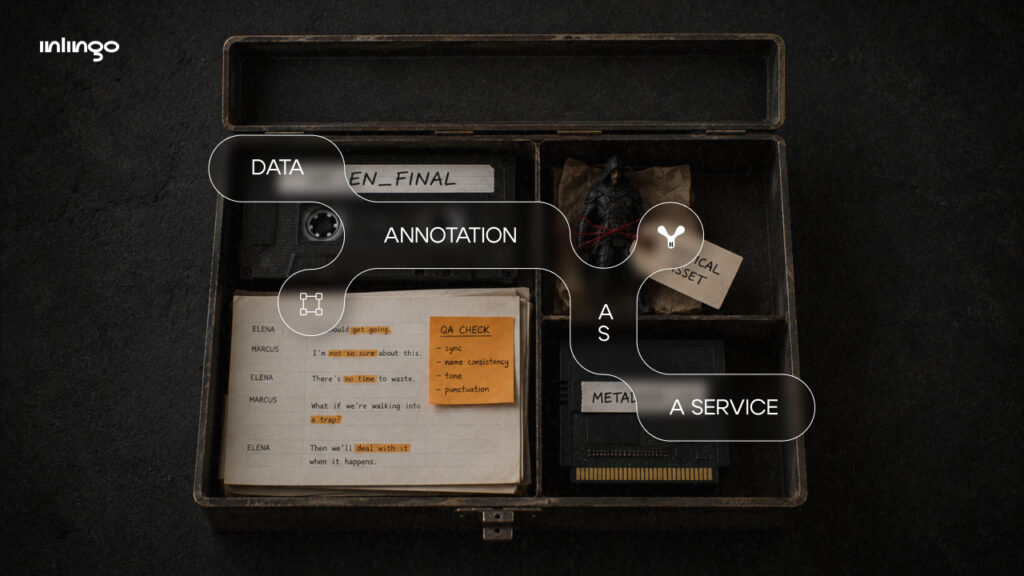
Data annotation is the process of turning raw data into a structured dataset. Text, images, audio, video, or user-generated content are assigned labels, categories, entities, ratings, transcripts, object boundaries, or other structured attributes. These datasets are then used to train, validate, and evaluate AI/ML models.
How Does It Differ from Post-Editing?
Post-editing focuses on correcting AI- or machine-generated output so it is ready to use. Data annotation goes further: instead of only fixing the output, annotators label, classify, score, explain, or structure it so the results can be used for model training, evaluation, analytics, and future quality improvement.
When Do I Need Data Annotation?
Your model needs training, validation, or evaluation datasets.
Your model fails on a specific language, genre, content type, or user group.
You need to create a gold set to check model quality or vendor output.
You need to evaluate LLM answers, select the best response, or label failure reasons.
What Do I Need to Set a Task?
The client should provide sample data, model or business goal, desired labels, output format, QA requirements, languages, domain, volume, deadline, and privacy requirements. If the sample does not exist yet, Inlingo can help design it during the pilot.
What Does the Client Receive?
The client receives a ready-to-use dataset in the required format: EXCEL, CSV, JSON, XML, spreadsheet, or client-specific schema. Deliverables can also include guidelines, a gold set, QA report, error taxonomy, and annotation statistics.
What Does the Process Look Like?
- Scope the task: model goal, data type, languages, labels, and output format.
- Create guidelines with examples, edge cases, and negative examples.
- Run a pilot on a small sample to measure speed and ambiguity.
- Annotate production data in batches with tracking by annotator.
- Run QA: reviewer pass, spot checks, gold set, IAA, and final audit.
- Deliver the dataset and quality report.
What exactly do you provide as data annotation?
Metadata Creation
We create structured metadata that makes content searchable, filterable, reusable, and ready for AI workflows. This includes language, topic, genre, speaker, platform, source, rights, sentiment, maturity rating, and custom taxonomy tags.
Classification and Topic Modeling
We classify multilingual text by topic, intent, sentiment, issue type, or custom labels. We can also discover recurring themes in large datasets and turn them into a clear taxonomy for analytics, support, moderation, or model training.
Transcription and Speech/Audio Labeling
We transcribe and label multilingual audio for ASR, speech analytics, voice products, and AI training. Our team can add timestamps, speaker labels, segmentation, noise tags, emotions, intents, and QA checks.
Toxicity Rewrite and Ethical Norms
We help AI and content teams identify toxicity, bias, harassment, hate speech, and other safety risks across languages and cultures. When needed, we rewrite unsafe or sensitive content into safer, policy-compliant alternatives.
| Service | Recommended Pricing Model | Notes |
| Metadata Creation | Per label / per field | Suitable for language, topic, genre, speaker, platform, source, rights, sentiment, maturity rating, and custom taxonomy tags. Works well at $0.02-0.05 per label if the taxonomy is already defined. |
| Classification | Per label or hourly | Best fit for topic, intent, sentiment, issue type, moderation category, or custom class annotation. This is the strongest candidate for unit-based pricing. |
| Entity / Tag Annotation | Per label / per entity | Suitable for named entities, keywords, speaker/topic tags, failure tags, or other extracted attributes. Can be priced per detected entity or completed field. |
| LLM Answer Evaluation | Per label or hourly | Simple labels such as good/bad, best response, category, or failure reason can be priced per label. Complex evaluation with explanations, ranking, or rubric-based judgment is better priced hourly. |
| MT / LLM Translation Annotation | Per label or hourly | Best for MQM/LQA, adequacy and fluency checks, error taxonomy, preference ranking, correction, and explanation of errors. Suggested rate: $40-80 per hour. |
| Topic Modeling / Taxonomy Discovery | Per label or hourly | Use hourly pricing when the task includes discovering recurring themes, building a taxonomy, writing label definitions, and resolving edge cases. |
| Guideline / Gold Set / Pilot Design | Per label or hourly | This is analytical setup work rather than production labeling. It should usually be priced separately from annotation volume. |
| QA / Reviewer Pass / Audit | Per label or hourly | Suitable for reviewer checks, spot checks, inter-annotator agreement, final audit, QA reporting, and resolving ambiguous cases. |
| Transcription | Per audio minute or hourly | Best for multilingual human transcription. Suggested rate: $X-X per audio minute, depending on language, audio quality, domain, turnaround time, and formatting requirements. |
| Speech / Audio Labeling | Per audio minute or hourly | Timestamps, speaker labels, segmentation, noise tags, emotions, and intents can be priced per audio minute when tied to transcription. Complex review or QA can be hourly. |
| Toxicity / Safety Labeling | Per label or hourly | Suitable for toxicity, bias, harassment, hate speech, safety risk,policy category, and severity labels when the taxonomy is predefined. |
| Toxicity Rewrite / Ethical Rewrite | Per label or hourly | Rewriting unsafe or sensitive content into safer, policy-compliant alternatives is closer to expert editing and policy work than simple labeling. |