What is TQE?
Translation Quality Evaluation (TQE) is a procedure for assessing the quality of translations using a unified approach across all the tasks or projects. TQE is applicable both to human and machine-translated output.
How Does It Differ from Editing?
Upon editing, the issues present in the translation are silently fixed. The editor’s feedback, if present, is usually generalized. Upon TQE, the focus is shifted from correcting the errors to classifying and measuring them. While editing is normally required for a whole amount of a text (a file or a set of files), TQE can be performed on a sample amount, making it more cost-efficient for large projects when compared to editing. However, TQE and editing partially overlap since TQE also provides corrections to the text under evaluation.
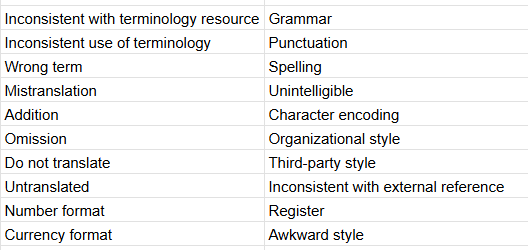
A portion of the error subtypes
How Does It Differ from LQA?
While both TQE and LQA are aimed at identifying and correcting errors, the difference between them lies in their purpose and scope. If LQA is normally performed by testing the product itself and also covers possible technical issues, TQE is focused on texts (or samples of texts) and provides a deeper linguistic assessment.
When Do I Need TQE?
TQE is useful if you want to:
- make sure that translation meets quality requirements
- compare the quality of translations across different languages or vendors
- keep track on the performance of your vendors (or AI/MT engines, if applied to machine translations)

A short depiction of TQE report with error description
What Do I Need to Set a TQE Task?
Basically, all you need is to send us the file for evaluation. You can also check if the default parameters of our evaluation scoresheet (e.g., error classification and error weights) work for your project. Any additional resources, such as style guide and glossary, can also be taken into account for assessment.
How Does the TQE Process Look Like?
- You send us the translations for evaluation. You can either send us only the segments you need to evaluate or ask us to prepare a randomized sample based on a number of words.
- We send you a TQE template which you can ask us to customize for your project if needed. For example, we can change the list of error types or make one type of error score more penalty points than the others. However, the default values work well in most cases.
- Our linguists evaluate the translation by classifying and describing the issues found in the text. The results of the evaluation are calculated to provide an overall quality score.
- The scoresheet is re-checked by our QA specialists to make sure that the evaluation conforms with the project requirements.
- You receive a final scoresheet with all the errors described and the overall quality score calculated.
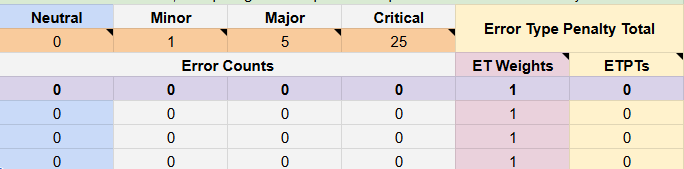
A short example of how error counts work
Based on the Established Standards
Our TQE service is based on the principles laid out in the Multidimensional Quality Metrics (MQM) framework and the ISO 5060:2024—Evaluation of translation output standard to ensure a unified approach while keeping the process flexible to suit your needs.
These standards also serve as a basis for the classification of errors and calculations used in our evaluation process.

Quick summary upon finishing