In game localization, so much content is being generated that people do not always have time to evaluate it. The most important part of content production is building a quality assurance system that ensures the content meets audience expectations. Over the past few years, we have been building a bridge from exclusively manual translation review to a system grounded in experience, statistical data, domain specifics, and the expertise of the people doing the work. This article presents some of what we have learned.
Why Game Localization Quality Management Matters More Than Ever
As much as we love translation and regard it as creative work that cannot be reduced to a single number, the world has genuinely changed. New achievements have to be demonstrated through metrics: improved indicators, positive or negative trends, charts, and clear conclusions. The goal of game localization quality control is therefore not to invent a “perfect score,” but to build a system that measures translation quality appropriately in today’s environment without losing sight of context.
Content volume is growing faster than team capacity. Live-service games release regular updates, events, patch notes, new items, and marketing assets. A single release can affect dozens of languages, multiple platforms, and several content types at once. At this pace, reviewing the entire content set is often impossible, while a single final proofreading pass identifies systemic issues too late.
Artificial intelligence (AI)-assisted translation further accelerates production and makes the content pipeline heterogeneous: human translation, machine translation, post-editing, and generated variants all appear side by side. Scalable game localization quality control must account for a segment’s origin, risk level, and required depth of review. Its purpose is not only to catch a typo before release, but also to identify where the likelihood of rejection, terminology violations, broken UI, or reputational damage is increasing.
The Foundation of Game Localization Quality: Human Review
Everything begins with video game translation and human review. A reviewer sees not only an individual segment but also understands the scene, character, gameplay mechanic, tone, UI constraints, and audience expectations. Only a human can distinguish an acceptable alternative from an error, assess humor, subtext, and cultural appropriateness, and recognize when literal accuracy undermines the player experience.
In a CAT tool, review is usually performed segment by segment. The reviewer compares the source and target text, consults the translation memory, glossary, style guide, and contextual materials, and then makes an approve/edit decision: approve the segment or revise it. If an edit affects the quality score, it should be assigned a category, a severity level, and a brief comment. In this way, localization quality control turns subjective editing into a repeatable process.
Human review is not 100 percent objective either. Two highly skilled reviewers may choose different but equally valid phrasings. It is therefore useful to distinguish required corrections from preferential improvements. This establishes consistent quality-control rules and protects translators from subjective, preference-based edits.
From Binary Checks to Game Localization Quality Metrics
Early quality-control systems often answered only one question: did the work pass review or not? A binary status is convenient for production, but it explains almost nothing. Two files may be rejected for entirely different reasons: one contains a broken critical tag, while the other has accumulated many minor stylistic edits. That distinction is insufficient for risk management.
A modern game localization quality-control system combines several layers of data: whether an error occurred, its category and severity, the volume of text reviewed, the content type, language, linguist, and process stage. The resulting metric answers specific questions: Is the project’s localized content ready for release? Which error type is recurring? Is the corrective action working?
Game Localization Quality Metrics
Metrics can broadly be divided into reference-based and reference-free metrics. BLEU, TER, chrF, and their derivatives compare a translation with a reference, but lexical variation does not necessarily indicate an error. Quality Estimation systems, including COMET-QE/COMETKiwi and commercial services such as TAUS EPIC, can evaluate a segment without a reference translation.
BLEU
Automated metrics have become widespread because they are fast and reproducible. One of the earliest and best-known metrics is BLEU (Bilingual Evaluation Understudy), which measures the n-gram overlap between a machine translation and one or more reference translations.
chrF (Character N-gram F-score)
Despite its popularity, BLEU is criticized for correlating poorly with human judgment, especially when evaluating high-quality translations or specialized-domain content, because it does not account for synonymy or semantics. Character-level metrics such as chrF (character n-gram F-score) offer an alternative. chrF measures overlap between character sequences and can sometimes correlate better with human ratings.
Translation Edit Rate (TER)
This metric is essentially an analogue of Levenshtein distance for translation quality evaluation. It reports the minimum number of edit operations required to transform a hypothesis into one of the references. The operations are insertion, deletion, substitution, and word reordering. TER measures the edit operations needed to transform a translation into a reference, including insertions, deletions, substitutions, and shifts. How capitalization and punctuation are handled depends on the implementation and its configuration.
At the same time, a lack of similarity to the reference does not automatically mean that a translation is wrong. A translation can be good and correct while still differing from the reference. In addition, there may be one reference or many, which also affects the final score.
MQM and TAUS: A Shared Language for Game Localization Quality
One of the industry’s key frameworks is Multidimensional Quality Metrics (MQM), a hierarchical typology that describes errors by dimensions, categories, and subcategories. The current MQM Core includes, among others, Accuracy, Terminology, Linguistic Conventions, Style, Locale Conventions, Audience Appropriateness, and Design and Markup. Each project selects a profile: it retains only the relevant branches, refines their definitions, and maps them to severity levels.
TAUS DQF (Dynamic Quality Framework) helped bring similar logic into operational analytics by enabling teams to collect structured data, compare results, and discuss quality using a common language. In current practice, MQM Core is best treated as the baseline typology, while DQF remains a historically and practically important set of evaluation processes and tools. This avoids debates over terminology and refocuses attention on what matters: whether teams interpret a specific error consistently.
Standardization is not about producing an attractive report. If one reviewer labels an incorrect character name as Accuracy, another as Terminology, and a third as Style, the aggregated statistics will be misleading. Calibration using examples, concise definitions, and an escalation rule for disputed cases matter more than an excessively complex taxonomy.
What Is PPM? Turning Quality into Measurable Data
Many companies begin with the ratio of errors to words – in other words, error density. This metric is simple: it allows samples of different sizes to be compared and supports an internal acceptance threshold. However, a statement such as “3-5 errors per 1,000 words is acceptable” is not a universal industry standard. The threshold depends on the content type, market, risk, review model, and whether preferential edits are counted as errors.
To compare tasks of different sizes, teams can use PPM – the number of errors per million words. This is one approach to translation quality measurement. In a simple, unweighted calculation, the formula is:
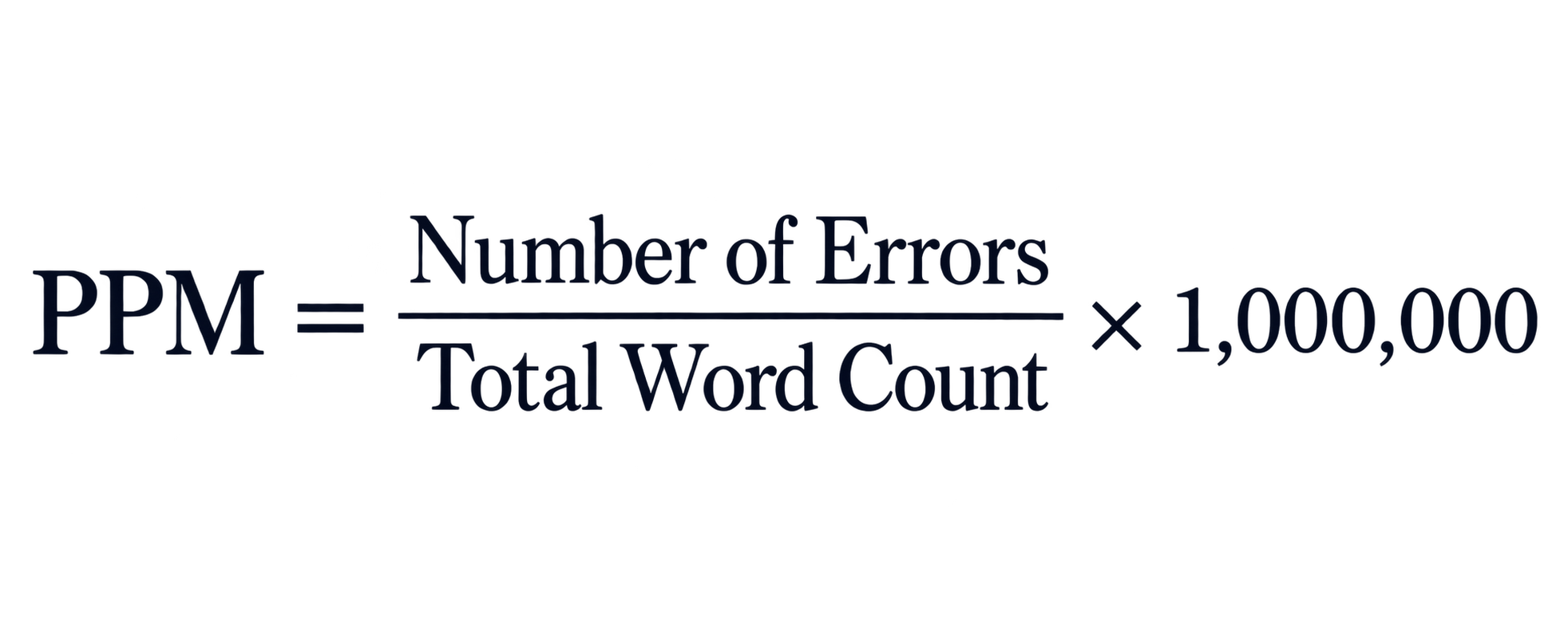
If 10 errors are confirmed in a 50,000-word sample, the PPM is 200. PPM can be calculated after each reviewed task and then aggregated by month or quarter. It measures error density, supports trend analysis, and can help assess rejection risk when interpreted alongside error severity and content type. However, it does not directly measure the effort required for rework. Illustrative thresholds such as 3,000 for human translation and 6,000 for MTPE may exist in an internal model, but they cannot be transferred to another project without calibration. PPM is not “quality itself”; it is one sensor within the system.
How Analytics Helps Game Localization Teams Improve Quality
Analytics becomes useful when it leads to action. Game localization quality metrics can be broken down by linguist, language pair, content type, platform, reviewer, translation source, and project version. This allows the team to see not only the average, but also where risk emerges – for example, an increase in terminology errors from a new vendor or a spike in character-limit issues after a UI change.
Linguists should be compared using comparable data. A translator working on complex dialogue should not appear weaker than a colleague who handled only repetitive menu strings. Fair quality control accounts for domain, complexity, MTPE share, the size of the reviewed sample, and the error profile.
The trend matters more than a single data point. A moving average, or at least the median across several tasks, helps distinguish a random outlier from sustained deterioration. If PPM increases, the team analyzes the root cause: ambiguous source text, an outdated glossary, insufficient context, incorrect routing, reviewer overload, or an actual performance issue. After the process changes, the metric is measured again; otherwise, the analytics remains nothing more than a chart.
Translation Error Categories in Game Localization
For translation error classification, we use a TAUS DQF/MQM-based framework adapted to game localization. This is a project-specific profile, not a claim that every category name listed below matches MQM Core verbatim.
| Category | What It Captures |
| Accuracy | Distortion of meaning, omission, unjustified addition, or an incorrect relationship to the source. |
| Fluency | Issues with grammar, spelling, punctuation, or naturalness in the target language. |
| Terminology and Consistency | Failure to follow the glossary, approved entity names, or consistency across strings and releases. |
| Style | Wording that does not match the character voice, genre, style guide, or purpose of the text. |
| Technical Aspects | Problems with tags, variables, formatting, limits, encoding, or display. |
| Regional and Cultural Adaptation | Insufficient cultural, regional, or platform-specific adaptation. |
| Client | An edit prompted by new information, a source-text change, or client clarification rather than a translator error. |
Why Error Severity Matters
The same number of errors can represent entirely different levels of risk. A typo in an optional description and an incorrect bundle price should not carry the same weight. Severity measures consequences, not how much a reviewer dislikes a particular phrasing.
A commonly used scale is as follows:
- Preferential: an acceptable variant that the reviewer improved based on personal preference or for greater expressiveness. It should not reduce the translator’s score as a confirmed error.
- Minor: a low-impact issue that does not impede comprehension or change the function of the text.
- Major: a clear error that affects meaning, quality, or the player experience but does not block the product as a whole.
- Critical: an issue that makes a function unavailable, breaks code, creates legal or reputational risk, violates a key requirement, or introduces prohibited content.
Critical severity is not normally applied to the Client category, while N/A is appropriate when the source text has changed and the previous translation matched the earlier version. Criticality decisions should be based on predefined examples. A stop-ship rule is also advisable: even with a low average PPM, a single confirmed Critical error may halt the release.
How to Evaluate Game Localization Editors and Reviewers
Suppose one reviewer consistently makes 5-10 edits per 1,000 words and another makes 50-100. The second might appear more effective. Yet a hundred edits may be unnecessary, while nine out of ten edits may be exactly right. The number of edits alone does not measure reviewer performance.
Precision, Recall, and F-score are useful for evaluation. First, an independent senior reviewer or an agreed adjudication process establishes a set of confirmed errors. The reviewer’s results are then compared not with the number of edits made by colleagues, but with this validated set:
|
Outcome |
Interpretation |
| TP (true positive) | The reviewer correctly identified and fixed a confirmed error. |
| FP (false positive) | The reviewer made an unnecessary or incorrect edit. |
| FN (false negative) | A confirmed error went undetected. |
For example, a reviewer found 36 confirmed errors, made 9 unnecessary edits, and missed 4 errors. Precision is 80%, Recall is 90%, and F1 is approximately 84.7%. High precision with low recall indicates cautious but incomplete review; high recall with low precision creates noise and unnecessary work. A universal target such as “precision must always be 80%” is risky: the acceptable balance depends on the cost of a missed error and the cost of a false positive.
CAT tools, where most of an LSP’s production pipeline takes place, are where the magic of translation happens. Automated localization QA can be run in the same environment without closing the window. These checks are good at identifying formal issues, but an unrefined rule often generates many false positives. It is therefore incorrect to assign all CAT-based checks a fixed “accuracy of 1-2%” or to assume that 99% of their results are noise. Effectiveness depends on configuration, context, and disciplined handling of results.
AI-Powered Game Localization QA
AI tools are most effective for first-pass triage: a model can quickly flag suspicious segments – terminology issues, discrepancies with reference materials, formatting errors, and abrupt tonal shifts – and route them to a reviewer. This approach improves AI-powered localization QA as a process: it reduces workload, accelerates the revision cycle, and keeps human judgment in the loop for disputed, context-sensitive cases.
Human-in-the-loop (HITL) means that AI proposes potential errors or corrections, while the final approve/reject decision, correction, and severity assignment remain with a human. LLM-as-a-judge is not the opposite of HITL; it is a role for the model: ranking alternatives, assigning a confidence score, or suggesting an error category. In production localization, the judge can operate within the HITL loop without becoming the sole arbiter.
Specialized model families such as Tower/Tower+ and scoring models such as COMETKiwi demonstrate how diverse evaluation tools have become. A model name does not eliminate the need for controls: teams must record the model and prompt versions, calibrate thresholds by language and domain, protect client data, measure false positives and false negatives, and regularly monitor drift.
CAT-Based QA
CAT-based QA remains the most reliable layer for deterministic requirements. It checks numbers, dates, placeholders, repetitions, terminology consistency, unclosed tags, forbidden characters, and other formal constraints. The strength of this layer is explainability: a rule shows exactly what was violated and behaves consistently when rerun.
Automated QA checks within CAT tools are particularly effective at identifying technical issues, including missing placeholders, broken tags, encoding problems, and formatting inconsistencies. However, their effectiveness depends heavily on rule configuration, language-specific requirements, and the nature of the content being checked. Poorly configured checks can produce numerous false positives, making human validation essential.
To reduce noise, rules must be tailored to the style guide, language, and file type. For example, a regular expression can identify a violation of spacing rules before French punctuation, but it cannot be applied unchanged to another language. The metric should be based on confirmed findings rather than the total number of warnings; otherwise, an active QA profile will appear worse than a carefully configured one simply because it produces more alerts.
Custom QA for Game Localization
Our company has developed a system of additional rules tailored to the style guide and client requirements. For game localization, particularly useful modules check platform terminology, variables, character or pixel limits, missing special characters and emoji, balanced and closed tags, and approved variants of character names and in-game entities.
Text-based QA, however, cannot see the entire product. It is supplemented by pseudolocalization, font and glyph coverage checks, UI overflow detection, plural and gender testing, subtitle and voice-over timing, and finally game localization testing and in-build localization quality assurance (LQA). Custom QA is especially valuable when a typical error is repeatable: after an incident, the team formulates a rule and turns a one-off lesson into automated protection for future releases.
How to Build a Closed-Loop Game Localization Quality System
Modern game localization quality control is a continuous cycle. Each step produces data for the next, and the outcome feeds back into production: Human Review – the reviewer confirms meaning, context, and the need for an edit; Error Classification – a confirmed error receives a consistent category; Severity Analysis – the team assesses impact and release risk; PPM Tracking – the result is normalized by volume and compared only with comparable samples; Editor Performance Metrics – Precision, Recall, and F1 measure the quality of the review itself; Quality Analytics – trends reveal the language, content, stage, or rule where an issue arises; Process Improvement – the glossary, style guide, training, routing, and QA rules are updated.
Conclusion
In 2026, game localization quality cannot be reduced to either an elegant translation or a single score. A robust system combines human expertise, consistent error classification, severity, normalized metrics, analytics, and automated checks. MQM and TAUS provide a shared language, PPM helps compare scale, Precision/Recall/F1 evaluate review quality, and AI accelerates risk detection.
The core principle remains simple: measure what helps people make decisions. If a metric does not explain why a problem occurred or what should change in the process, it becomes reporting for reporting’s sake. When Human Review, Error Classification, Severity Analysis, PPM Tracking, Editor Performance Metrics, and Quality Analytics are connected through feedback loops, game localization quality control becomes a system of continuous improvement – transparent to the team and clear to the client.
For developers and publishers comparing video game localization services, this transparency also makes it easier to evaluate a game localization company and its quality process.